(May 30, 2026)
Don’t want to read? No Problem, listen to audio below:
Part 1
Part 2
Black Star Canyon is a place rich in history, mystery, and folklore, making it a location we were eager to explore. Nestled within the Santa Ana Mountains of eastern Orange County, California, the canyon has a fascinating past that extends far beyond the ghost stories for which it has become well known. The canyon received this name in the late 1870’s when the Black Star Cole Mining Company discovered coal deposits.
Long before Spanish explorers and American settlers arrived, Black Star Canyon was part of the traditional homeland of several Indigenous peoples who depended on its abundant natural resources. Its oak woodlands, year-round springs, and diverse wildlife made the area an important seasonal gathering place for hunting, food collection, trade, and cultural activities. Archaeological evidence suggests that Native peoples occupied and utilized the canyon for hundreds—if not thousands—of years.
The Indigenous peoples most closely associated with Black Star Canyon include:
- Gabrielino/Tongva Nation (historically referred to as Gabrieleno)
- Acjachemen Nation (historically called Juaneño by the Spanish)
- Serrano (Yuhaviatam) people, who occupied the nearby San Bernardino Mountains and maintained trade and cultural relationships with neighboring communities.
Although Black Star Canyon is most commonly associated with the Tongva people, archaeological research indicates that the canyon served as a shared landscape where the Tongva, Acjachemen, Serrano, and neighboring groups interacted. The area was used seasonally for gathering acorns, hunting deer and small game, collecting native plants, and traveling between coastal and inland villages.
Puhú Massacre of 1831
One of the most tragic events associated with Black Star Canyon is the Puhú Massacre of 1831. Historical accounts describe a violent attack on the Indigenous village of Puhú, located within the canyon, by a group of American and Mexican fur trappers led by frontiersman William Wolfskill. According to traditional accounts, the conflict arose after Native residents took horses and other livestock from nearby Mexican ranchos, actions believed by many historians to have been driven by the severe disruption of their traditional way of life following Spanish and Mexican colonization.
The trappers tracked the livestock to Puhú and launched a surprise assault on the village. Armed with firearms, they overwhelmed the inhabitants, resulting in the deaths of many Indigenous men, women, and children. A small number of villagers reportedly escaped into the surrounding mountains, while the village itself was destroyed, marking the end of one of the region’s most significant Indigenous communities.
Although historians continue to examine and debate certain details of the event—including the exact date, the number of victims, and aspects of the historical record—there is broad agreement that Indigenous people lost their lives in Black Star Canyon during this period. Today, the Puhú Massacre is remembered as one of the darkest and most significant chapters in the canyon’s history, serving as a solemn reminder of the devastating impact of colonization on Southern California’s Native peoples.
Our Experience
During our four-hour historical and paranormal hiking tour through Black Star Canyon, we had the opportunity to learn about the canyon’s remarkable history while exploring many of the locations connected to its legends and folklore.
We booked our tour through OC Haunted, and we cannot recommend them highly enough. Their knowledgeable guides provide an outstanding experience that combines local history, folklore, and the natural beauty of the canyon. We were especially fortunate to have Barefoot Joel from Naturalist For You as our guide. His extensive knowledge of the area’s history, wildlife, geology, and Indigenous heritage made the tour both educational and engaging.
Throughout the hike, Joel shared far more historical information than we could possibly include here. We left with a much greater appreciation for how Black Star Canyon received its name, the people who once called it home, and the significant events that shaped its history. Whether you are interested in local history, nature, or the paranormal, we highly recommend taking this tour or researching the areas history further.
Our Paranormal Investigation
Because we wanted to be respectful of the tour experience and avoid disrupting other participants, we limited our paranormal equipment to a body camera and digital audio recorder, both of which we used with permission throughout the hike.
During our investigation, we captured several Electronic Voice Phenomena (EVP’s). Although we did not capture any unusual photographic evidence, we were intrigued by several audio recordings that appear to contain speech unlike English or Spanish.
After reviewing the recordings and researching the Tongva language, we found descriptions that characterize it as:
- Crisp and rhythmic, with clearly pronounced syllables.
- Rich in hard consonants such as k, kw, ch, t, and glottal stops.
- Balanced by open vowel sounds that create a flowing cadence despite the prominent consonants.
Several of the EVP’s we captured appear to contain speech with similar phonetic characteristics. While we cannot conclude that the recordings are Indigenous language, we believe they warrant further investigation. Our goal is to consult individuals with expertise in the Indigenous languages of Southern California to obtain a more informed analysis. If we receive additional information, we will gladly provide an update.
The Hanging Tree EVP
One particularly interesting EVP was captured near the location of a tree that has long been associated with stories of hangings in Black Star Canyon. While the original tree has largely deteriorated over time, the site remains an important part of the canyon’s folklore and history.
While standing near the tree, our webcam captured what sounds like a male voice saying, “Go long.”
As we reviewed the recording, we considered whether the phrase might relate to historical references associated with executions by hanging. While expressions such as “the long drop” are historically associated with one method of execution, we found no historical evidence that “go long” was itself a documented phrase used in that context. Because of this, any connection remains entirely speculative.
Given the location where the EVP was recorded and our previous investigations at historic hanging sites, we found the timing and content of the recording particularly intriguing. However, we cannot determine its origin or intended meaning, and we present it simply as one of the more unusual pieces of audio evidence captured during our investigation.
An Unexpected Highlight
Not everything about the evening was paranormal. One of the most memorable—and surprisingly fun—experiences was scorpion hunting.
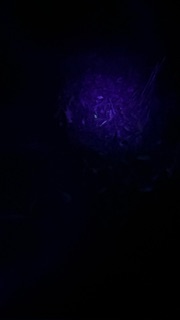
Using UV flashlights provided by our guide, we searched the rocky terrain after dark. To our amazement, the scorpions glowed a brilliant green beneath the ultraviolet light as they hid among the rocks. As soon as they were illuminated, many quickly retreated into small crevices, and we could even hear them scrambling across the rocks.
It was an unexpected part of the evening that everyone on the tour thoroughly enjoyed. Never did we imagine we’d spend part of a paranormal hike searching for glowing scorpions, but it quickly became one of the highlights of the night.
Final Thoughts
Our experience at Black Star Canyon was educational, fascinating, and unforgettable. The combination of rich Indigenous history, local folklore, natural beauty, and our own paranormal investigation made for an incredible evening that exceeded our expectations.
Below, we have shared some of the videos, audio recordings, and photographs we collected during our investigation. While these are only a selection of the evidence we captured, they represent some of the clearest and most compelling pieces from our experience.
We look forward to continuing our research into the possible Indigenous language captured in our recordings and uncovering more about the many mysteries surrounding Black Star Canyon. We hope you enjoy reviewing our evidence as much as we enjoyed experiencing this remarkable location.
Webcam*:
Below is a list of some webcam recordings we received during our investigation. These were some of the most compelling and clear sounding webcam recordings we received. Unfortunately, we did not receive any visual evidence but did capture recorded voices. We highly recommend you use headphones while you listen. Enjoy!
Video 1 – While standing near the hanging tree, our webcam captured what sounds like a male voice saying, “Go long.” This video is black due to how dark it was outside. (0.4-0.5).
Video 2 – You hear what sounds like a male say something like “Bak-O”. It is hard to determine what this word is but could be of an indigenous language. What do you think? (0.3-0.4)
Portable Audio Recorder*:
Below is a list of some recordings we received with a portable audio recorder during our investigation. These were some of the most compelling and clear sounding recordings we received. We highly recommend you use headphones while you listen. Enjoy!
Audio 1 – You hear what sounds like a female saying three possible words that do not sound English. Could this be indigenous language. (0.6-0.8)
Audio 2 – You hear what sounds like a women say “hey” (0.8)
Audio 3 – You hear what sounds like a male say what sounds like “Red Bones”. (.06-.07)
Audio 4 – You hear what sounds like a women say “Somewhere” twice. (0.8-0.10)
Black Star Canyon Pictures*:
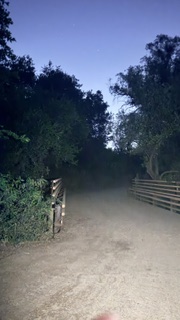
We were not able to find any anomalies.
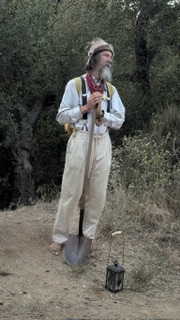
Barefoot Joel
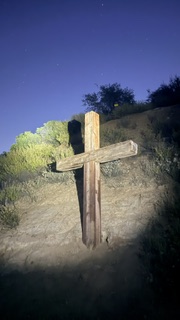
Cross put up by a church near coal canyon entrance
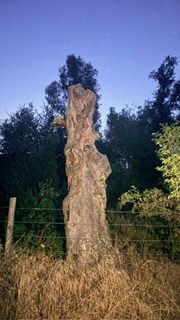
Hanging Tree
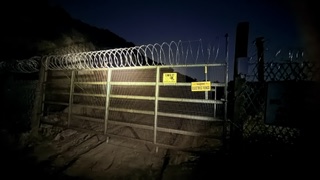
Fence blocking mine entrance
Trail
Glowing Scorpion with LED light